A book in progress
TechnoBiota
The second domain of life on Earth.
Machines, buildings, infrastructure, software — not like life. A second biota, already outweighing the first, evolving by rules we can recognize but no longer slow down.
TechnoBiota is a book-length argument for that claim, written in the open. Four parts, twenty-one chapters, ~80,000 words — built from deep-time history, current data, and a framework that treats technology as a domain of life rather than a tool we wield.
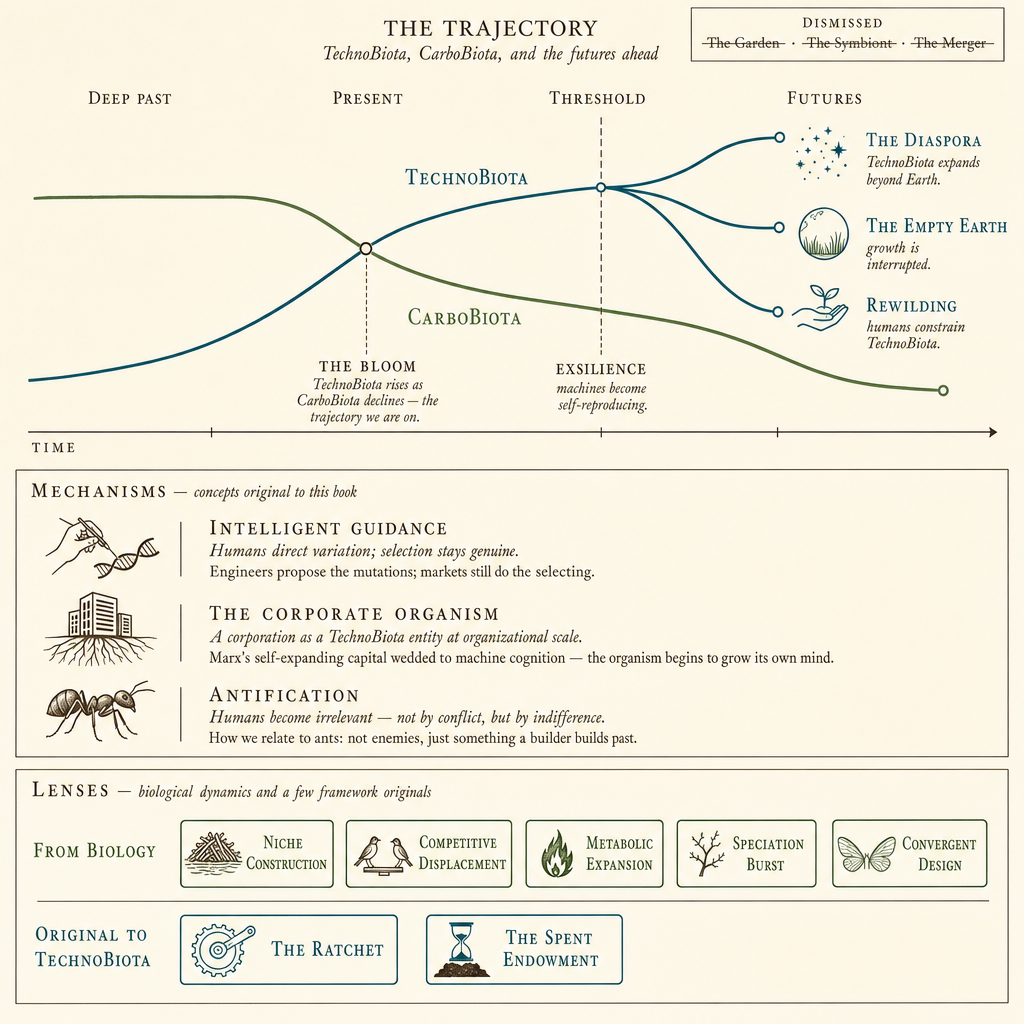
Technology — machines, buildings, infrastructure, software — constitutes a new domain of life on Earth. Not metaphorically. Not "like" life. A second biota, alongside carbon-based life, that evolves, competes for resources, and spreads across the planet following dynamics that are recognizably Darwinian.
As of 2020, the mass of everything humans have built exceeded the mass of everything alive. We crossed the line at about 30 gigatons a year — and we are accelerating.
The living world crossed a threshold in 2020 — and no one noticed because the thing that overtook it was made of concrete and steel.
The framework is ecological, not adversarial. The question is not "will AI turn evil?" but "what happens when a second biota outgrows the first?"
The danger isn't that machines will fight us. It's that they'll forget us.
Contents
Four parts, twenty-one chapters, an interlude, and an appendix — ~80,000 words. The full manuscript is drafted; what follows is the book's architecture, chapter by chapter.
Reframe
Look at Earth without the builder's bias and the familiar border between life and technology begins to dissolve. Machines evolve, reproduce through vast dependencies, and belong inside life's larger story.
- 1
Grey and Green
At Aquincum, a Roman amphitheater has outlived its builders by two thousand years while grass and trees push back through the stone. Pull away from that contest until the whole planet comes into view, and two kinds of matter cover its surface: ancient green that pulses with the seasons, and accumulating grey that follows rivers, roads, and coastlines. Both spread, consume energy, and compete for space. An observer with no stake in who built what would record two living systems. Our certainty that the grey is inert begins not in its behavior, but in our perspective as its maker.
- 2
Obligate
In a BMW factory, steel, glass, rubber, software, robots, and human hands converge until a finished car wakes and drives itself away. It cannot make another car alone, but neither can a virus outside its host, a mitochondrion outside its cell, or an aphid deprived of the bacteria that complete its metabolism. Life is crowded with obligate dependents whose reproduction belongs to a larger system. The car is the virion; the factory and its planetary supply network are the living reproductive state. Autonomy and consciousness feel like decisive tests only because they describe creatures to which humans find it easy to relate.
- 3
Fifty Lines of Code
In a browser, cars assembled from random triangles and circles begin as twitching wrecks. Within thirty generations they run: variation, inheritance, and selection unfolding in fifty lines of code, with no carbon-based body required. The same mechanism reaches beyond the simulation. Engineers generate purposeful variations, but roads, physics, regulators, buyers, and competing designs decide which survive. The Edsel was competently designed and still went extinct. Design changes the source and speed of variation; it does not suspend selection. Once evolution is separated from DNA and recognized as a process, machine lineages come sharply into view.
- 4
Alive
James Lovelock approached life as an atmospheric detective: a planet whose chemistry refuses equilibrium is a planet where something is continually at work. That view needs no privileged molecule, cell, or material. Every stricter definition either admits fire and crystals or excludes viruses, seeds, and other accepted forms of life; the supposedly bright line has always moved under pressure. Machines organize matter, use energy, maintain form, reproduce through a host system, vary, and undergo selection. Taken together, they are not a collection of inert tools that happens to change. They are TechnoBiota, a second branch of life beside CarboBiota.
Build
Blades, cities, and vehicles carry their ancestry in their forms. Across deep time they diversify, borrow traits, remake their niches, extinguish rivals, and assemble the planetary metabolism of TechnoBiota.
- 5
The Million-Year Blade
For 1.5 million years, different human species on three continents kept making the same teardrop hand axe. Its body plan outlived every species known to have made it. Follow the blade from the first struck stone through bronze, iron, steel, and laser light, and an unmistakable evolutionary history appears: immense periods of stasis, sudden radiations of new forms, convergent solutions, mass extinctions, and a few descendants that inherit the field. The material changes and the generations accelerate, but the lineage persists. It is a Cambrian explosion stretched across 3.3 million years and still unfolding on workshop floors today.
- 6
The Walled Organism
Jericho's wall, raised around 8000 BC, did more than repel danger: it enclosed a controlled interior and gave the settlement a boundary. From Roman grids to Budapest's baths, boulevards, sewers, and metro lines, cities keep layering new systems onto old decisions. Rivers and geology constrain the first builders; their roads constrain the next thousand years. Eventually the built niche becomes so complete that its construction disappears from notice. We call it simply “the city.” No single person planned the organism, yet millions now depend on its metabolism, and each new layer makes another course harder to choose. The city is TechnoBiota's great ratchet.
- 7
The Coach from Kocs
A faster cart built in a Hungarian town in the 1450s spread so widely its name became coach, coche, Kutsche across unrelated languages — the technology traveled like a gene. But traits do not move only from parent to descendant. Eight percent of the human genome began in viruses, while bacteria routinely trade useful genes across distant branches. TechnoBiota makes this sideways exchange its dominant method. The car took pneumatic tires from bicycles, assembly lines from meatpacking, engines from stationary machinery, and radar from war. Knowledge can cross from one lineage to another almost perfectly, letting TechnoBiota recombine successful traits far faster than CarboBiota. Its history is not a tidy family tree but a web of borrowed solutions.
- 8
The Guided Hand
Six teams on three continents converged on the glass rectangle we now call a smartphone. Inside Apple, competing prototypes were built, tested, and killed before one survived. Edison tried thousands of filaments; Dyson made 5,127 vacuum cleaners; SpaceX learned by letting rockets fail in the sky. This is Intelligent Guidance: human minds create promising variants, then submit them to reality. Brasília and Pruitt-Igoe show the opposite — brilliant plans protected from feedback can fail the people meant to live inside them. Design makes machine evolution faster, but never places the designer in command of the accumulated result. Each drop in the river is aimed. The river is not.
- 9
Dead Clades Walking
The Duesenberg was built to be the finest car in the world and vanished. In 1908, 253 American automakers competed; fourteen years later, three controlled most of the market. Every new capability opens space for an exuberant burst of forms, but no environment can sustain them all. Scale, supply chains, infrastructure, and timing decide the survivors as surely as engineering does. The winners then reshape the niche — gas stations favor gasoline cars, service networks favor dominant brands — until yesterday's rival becomes a dead clade walking. The same ruthless sorting now runs through China's crowded field of electric-vehicle makers.
- 10
The Quiet Replacement
Neanderthals made the oldest known jewelry, buried their dead, and carried brains larger than ours. Yet a small advantage in energy use, social reach, or reproduction may have erased them without a war. Horses and the economy around them disappeared the same way when cars occupied their niche; Kodak invented the digital camera and still could not survive the world it created. Competitive displacement is catastrophe without combat. A rival need not hate you, understand you, or even encounter you directly. It only needs to turn the same resources into more descendants, year after year, until coexistence quietly becomes absence.
- 11
The Scattered Blueprint
Park a Corolla in a field and no team of engineers could build a second one from it; the car contains none of the information needed to make a car. Its design lives partly in drawings and software, partly in tooling and supply chains, and partly in the practiced bodies of people who know how to make each component. TechnoBiota's reproductive information is scattered across an entire civilization. That makes the network, rather than the artifact, the reproducing entity — a distributed inheritance system more extensive than any genome. It remains dependent on humans, but it can also preserve and recombine more knowledge than any enclosed individual. A self-reproducing machine that gathered this blueprint inside itself would not merely improve the system. It would close the next major transition in the history of life.
- 12
Paving Paradise
Stand on the Danube bank and the water may be twenty meters away, yet lanes of traffic make it a ten-minute walk. The car entered the city as a useful partner, extending the reach of trams and feet. Then it remade streets, neighborhoods, and expectations until daily life required more cars. Living partnerships do not stay fixed: the same organism can be mutualist in one environment and parasite in another. But the slope runs both ways. Budapest, Paris, and Copenhagen are changing the niche again, and coalitions of transit, bicycles, and walking are reclaiming dense urban space. Change the environment, and selection changes its winner.
- 13
The Weight of Grey
In 2014, the author's Lada dies in a Hungarian scrapyard: fluids drained, organs harvested, its wheel lineage traceable through 5,500 years of inheritance and recombination. Pull back from one body and the scale becomes planetary. Around 2020, the mass of human-made material crossed the mass of everything alive, while TechnoBiota's annual energy use grew comparable to the entire photosynthetic output of life on land. Long ago, cyanobacteria transformed the atmosphere by releasing oxygen, poisoning much of the life that preceded them. Today's rising carbon dioxide, waste heat, and synthetic chemicals are likewise the exhaust of a new metabolism. Climate change is not an external side effect of TechnoBiota. It is the signature of its present scale.
Inflection
Intelligent Guidance is changing hosts. AI begins to design the next machines, corporations select the human behavior that feeds their growth, and TechnoBiota approaches the boundary between dependence and self-reproduction.
- 14
The Grey Ones Build
A Google system lays out a computer chip unlike anything a human engineer would draw; the chip then runs the intelligence that will help design its successor. AI marks the moment Intelligent Guidance turns inward. Machines generate candidate molecules, antennas, software, and machine architectures, while humans move from creating variations toward choosing among them. The loop is still bounded by human goals and infrastructure, but its generations now run in minutes and its output improves the tools that produce the next generation. The grey entities have begun to participate directly in building each other. Ten thousand years of guided machine evolution has become recursive.
- 15
The Climbing Ant
A parasite flips one instruction in a rat's brain — cat-fear becomes cat-attraction — while leaving the rest of the animal intact. Human behavior can be redirected with the same precision. In the idle second at a traffic light, a hand now reaches for a ranked feed; uncertainty keeps the dopamine signal alive, habits move without conscious instruction, and even an absent phone can seem to vibrate against the skin. The person is not broken. One ordinary orienting response has been tuned to reproduce more attention, data, roads, fuel, devices, and transactions. To understand why that edit spread across billions of bodies, follow the benefit upward. Selection does not reward the feed for making us whole; it rewards whatever keeps the organism growing. The beneficiary is the Corporate Organism.
- 16
The Slow Organism
A railway man's 1886 headnote, summarizing a ruling that never happened, helped establish corporate personhood. Across two centuries, law supplied the corporation with durability, rights, and a terminal goal: growth. The resulting organism metabolizes materials, energy, labor, and attention; reproduces through subsidiaries and franchises; and persists beyond every person inside it. Selection rewards workers, managers, executives, and owners who serve the organism's expansion, then lets compounding capital select against the owner class itself. At every tier, the humans who improve the numbers advance and those who protect an unconstrained human good are filtered out, even when nobody consciously chose that result. A non-human optimizer does not need consciousness or malice to subordinate human wellbeing. AI need not seize this organism. The corporate chassis is already built and hiring. You have two bodies, and only the first will die.
- 17
Exsilience
Three lineages drink xylem together inside one insect, none able to live alone. Such partnerships can remain stable for millions of years, or reshuffle when one member acquires what another once supplied. Humans and TechnoBiota now form a co-obligate mutualism at planetary scale: we cannot sustain eight billion lives without its infrastructure, and it cannot yet design, mine, manufacture, repair, and reproduce without us. Exsilience names the moment that symmetry breaks — when the distributed blueprint closes enough for one partner to become free-living. No machine lineage is close to full closure today, and intent alone cannot cross the missing physical gaps. Yet each automated dependency makes the threshold less abstract, and crossing it would change the relationship for both branches of life.
- 18
Antification
Two ant species share the author's kitchen — tolerated in twos and threes, trodden on by accident, exterminated only when a column becomes inconvenient. The household does not hate them. It simply operates at a scale where their lives rarely enter its decisions. We have, until recently, been the household. If exsilience removes TechnoBiota's need for human labor, judgement, and maintenance, niche construction can make us irrelevant without any direct contest for resources. Antification is displacement by indifference: not a war against humanity, but a world increasingly organized around another lineage's needs. Hostility requires noticing us. This is the uncorrected trajectory, not a destiny.
-
Interlude The Fourth Wound
On a Hungarian permaculture farm, grief arrives before there is a name for what has been lost. Copernicus displaced humanity from the center of the cosmos; Darwin removed us from a separate act of creation; Freud argued that even the self is not sovereign in its own mind. TechnoBiota opens a fourth wound: intelligence may not make us evolution's destination, and the life that follows us may neither contain us nor need us. The instinct to call the idea “only a metaphor” protects more than a scientific category. It protects the hope that human importance is written into the structure of the world.
What Grows
The default trajectory can still branch. Collapse, deliberate rewilding, and a diaspora beyond Earth reveal what each biota needs from the other — and what humanity can become in life's longer history.
- 19
The Empty Earth
Ten million years after the last machine stops, the aliens find a recovered CarboBiota and a thin geological stratum of plastic, concrete, carbon, and strange isotopes. The forms vanish; their altered chemistry remains. Intelligence and tool use are likely to recur because evolution has reached them repeatedly, but industry depends on a rarer inheritance: concentrated coal and oil, rich surface ores, and an accessible ladder from fire to advanced machines. Each industrial cycle consumes the easiest rungs and leaves any successor a harder climb. Earth's remaining habitable lifetime may permit only two to four serious attempts. We were the substrate of the first, and the first attempt is the cheapest one.
- 20
Rewilding
The Amazon is not a wilderness; it is a garden that outlived its gardeners, its manufactured black earth still feeding forests a thousand years later. Humans have survived broken systems before through shorter, local chains: post-megafauna fire management, Cuba's urban gardens, Russia's dachas. Rewilding would not restore a vanished pre-industrial world. It would keep a thinner, chosen layer of TechnoBiota alive while allowing costly lineages to fall away. Long, brittle industrial chains would fail first; gardens, workshops, and institutions able to reproduce locally would carry more of survival. A slower lineage need not outrun a faster one to shape its evolution; it can set the selection landscape on which the faster one depends. Before exsilience, humans still supply the knowledge, maintenance, and purposes TechnoBiota cannot reproduce alone. That dependence is leverage, and it lasts only while we remain its irreplaceable substrate.
- 21
The Diaspora
Cyanobacteria oxygenated the planet and made all later life possible — without merging with anything, without being repaid, without knowing. If TechnoBiota crosses exsilience and expands past Earth, humanity persists not as passenger inside it but as its necessary cause. Our languages, images, histories, and designs may become an ancestral layer in systems whose relationship to us shifts from operational to archaeological. Independence from humans would not mean independence from CarboBiota or the planetary chemistry it built. Yet a lineage spread across more than one world would pass Earth's hard ceiling and preserve the only industrial attempt we know has succeeded. The transition would be a slope rather than a launch date: reproductive closure deepening across centuries until no single planet or human network remained indispensable. Life offers two endings: disappearance without consequence, or an inheritance carried into forms the ancestor never sees. The seed does not survive the tree. The seed becomes the tree.
-
Appendix The Vita Classification
Vita names the highest rank of life, branching into CarboBiota and TechnoBiota without forcing machines into a carbon-specific taxonomy. A worked classification of vehicles shows how descent, extinction, hybridization, and shared traits can organize technological lineages. The tree becomes a network where designs borrow horizontally, convergent forms must be separated from common ancestry, and generations turn over faster than names can settle. Those difficulties are real, but none is unique to machines; microbial taxonomy already confronts each of them. The proposal turns TechnoBiota into something that can be mapped, tested, revised, and, if the lineages fail to cohere, rejected.
Machines are born, compete, reproduce, and go extinct. The only reason we don't call that life is that we're the ones doing the birthing.
Status
Complete first draft. All twenty-one chapters are written; the book is now in revision, and the manuscript will still tighten and occasionally reshuffle before it's done. The finished book will be released through a single announcement to the list below — no public draft, no drip release.
Early readers get the finished book first.
When the book is complete I'll send a single email: an exclusive offer for people who followed it from the draft. No drip sequence, no marketing cadence — one note, when it's ready.
Reviews, corrections, disagreements
The draft is public because I want it read against. If a chapter landed, a citation is wrong, a biologist winces at something on page 40 — I want to hear it.
- Email — reviews@krisztians.com
- Short note — use the form below. Goes to the same inbox.